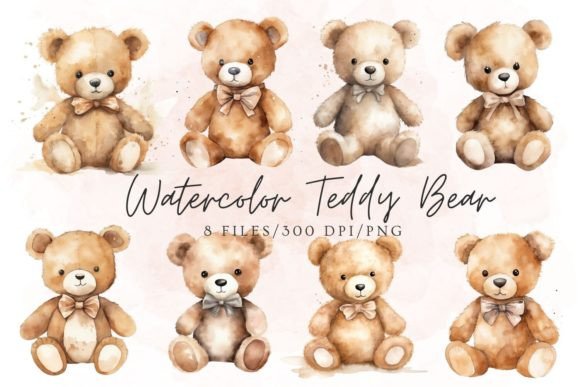
Integrating Watercolor Teddy Bear Clipart into Professional Creative Workflows
For designers, educators, and small business owners, selecting visual assets is rarely just about aesthetics; it is a strategic decision that impacts production timelines, brand consistency, and audience engagement. Watercolor teddy bear clipart occupies a specific niche within the digital asset ecosystem, bridging the gap between nostalgic warmth and professional polish. Unlike generic vector icons or stark stock photography, watercolor illustrations offer an organic texture that softens commercial messaging while maintaining high visual interest. Understanding how to leverage these assets effectively requires moving beyond simple decoration and viewing them as functional components of a broader creative or operational process.
In a practical workflow, this type of clipart serves as a modular design element. It is not merely a picture of a bear; it is a solution for conveying comfort, childhood development, artisanal quality, or gentle care without requiring custom illustration commissions. For professionals managing tight deadlines, having a curated library of high-quality watercolor assets allows for rapid prototyping and consistent output across multiple deliverables, from social media graphics to educational worksheets and product packaging.
Strategic Asset Selection and Pre-Project Planning
The integration of watercolor teddy bear clipart begins long before the design software is opened. Effective implementation starts with auditing project requirements against available assets. Professionals should evaluate clipart based on technical specifications and stylistic coherence rather than individual image appeal alone. A single charming illustration may fail if it clashes with existing brand typography or lacks the resolution necessary for print production.
During the planning phase, consider the following technical and aesthetic factors to ensure smooth execution:
- Resolution and Scalability: Verify that files are at least 300 DPI for print projects. While watercolor has natural soft edges, pixelation destroys the illusion of traditional media. For scalable needs, prioritize SVG formats or high-resolution PNGs (4000px+) to allow for cropping and resizing without quality loss.
- Background Transparency: Ensure assets have clean, transparent backgrounds. Poorly removed backgrounds create significant post-production work. Test edges against both light and dark backgrounds to check for white halos or jagged masking artifacts.
- Style Consistency: Watercolor varies wildly from loose and abstract to tight and realistic. Select a cohesive collection from a single artist or foundry to maintain visual continuity across a campaign or curriculum. Mixing disparate watercolor styles creates a disjointed user experience.
- Licensing Clarity: Confirm usage rights specifically for your intended application. Commercial licenses for physical products often differ from digital-only licenses. Documenting license terms during acquisition prevents legal bottlenecks during future audits or scaling efforts.
By addressing these variables upfront, teams avoid the common pitfall of falling in love with an asset that is technically unsuitable for the final deliverable. This preparation phase transforms clipart from an afterthought into a foundational design system component.
Workflow Integration Across Design and Education
Once assets are vetted, their application depends heavily on the specific professional context. Watercolor teddy bear clipart functions differently in a marketing funnel than it does in an early childhood education setting, though the underlying principle of emotional resonance remains constant.
Commercial Branding and Product Design
For entrepreneurs and marketers targeting parents or promoting wellness products, this imagery acts as a trust signal. In packaging design, watercolor textures suggest natural ingredients, handmade quality, or gentleness. When integrating these assets into product labels or website headers, treat them as textural elements rather than focal points. Use blending modes like "Multiply" or "Overlay" in Photoshop or Affinity Photo to let background colors show through the watercolor washes, creating depth and preventing the artwork from looking like a sticker pasted onto the design.
In digital marketing, these assets perform exceptionally well in seasonal campaigns and email newsletters. They break up dense text blocks and increase dwell time by adding visual warmth. However, balance is critical. Overuse can make a brand appear juvenile. Pair watercolor bears with clean sans-serif typography and ample whitespace to maintain professional authority while benefiting from the illustrative charm.
Educational Content and Child Development Resources
Educators and curriculum developers utilize watercolor teddy bear clipart to create emotionally safe learning environments. Unlike bright, saturated cartoons which can sometimes overstimulate, the muted tones of watercolor support focus and calmness. In worksheet creation, use these illustrations as visual anchors for instructions or as reward elements. The organic nature of the medium aligns with Montessori and Reggio Emilia philosophies that emphasize natural materials and gentle aesthetics.
When designing interactive digital learning tools, ensure the clipart is optimized for web performance. Convert large PNGs to WebP format to reduce load times without sacrificing the subtle gradients that define the watercolor style. For printable resources, always provide a grayscale version alongside the color version to accommodate schools with limited printing budgets and to support accessibility standards for visually impaired users who rely on contrast.
Technical Execution and File Management
Efficient workflows require robust organization. As libraries of watercolor teddy bear clipart grow, retrieval speed becomes a productivity metric. Implement a standardized naming convention that includes descriptive tags, color palettes, and license types. For example, bear-sitting-pastel-blue-commercial-use.png is infinitely more searchable than img_4920.png.
Consider using digital asset management (DAM) tools or even structured cloud folders with metadata tagging. This reduces friction when multiple team members need access to assets. When working in collaborative environments like Figma or Canva, create shared component libraries containing pre-approved watercolor elements. This ensures that freelancers and junior designers use only vetted, on-brand assets, maintaining quality control without constant supervision.
Post-production refinement is often necessary to seamlessly blend clipart into new compositions. Keep non-destructive editing practices in mind:
- Color Grading: Use adjustment layers to match the clipart’s color temperature to your project’s palette. Watercolor scans often carry paper texture or yellowing that may need correction via Curves or Levels adjustments.
- Edge Refinement: If masking is required, use layer masks rather than erasers. Feather edges slightly to preserve the bleeding effect characteristic of real watercolor paint.
- Texture Overlay: To unify disparate elements, apply a global paper texture overlay above all layers. This ties digital compositions together and enhances the authenticity of the watercolor aesthetic.
Evaluating Outcomes and Long-Term Asset Value
The true measure of successful integration lies in performance and longevity. After deployment, assess how watercolor teddy bear clipart contributes to project goals. In marketing, track engagement metrics on visuals featuring these assets versus those that do not. Do they increase click-through rates on parenting-focused ads? In education, gather feedback from teachers and students regarding usability and emotional tone. Does the imagery aid comprehension or distract from learning objectives?
From a business perspective, view high-quality clipart collections as capital assets rather than disposable expenses. A well-curated library pays dividends over years of use. Rotate assets seasonally to keep content fresh while maximizing ROI on initial purchases. Archive unused variations systematically; trends cycle, and today’s overlooked asset may be next year’s hero image.
Sustainability in creative workflows also means respecting artist labor. Supporting independent illustrators through proper licensing ensures the continued creation of authentic, high-quality watercolor art. Avoid AI-generated imitations when genuine craftsmanship is needed, as audiences increasingly value human touch in an automated world. Authentic watercolor carries imperfections and intentionality that resonate deeply with viewers seeking connection.
Optimizing for Accessibility and Inclusivity
Professional implementation must include accessibility considerations. Watercolor teddy bear clipart should enhance, not hinder, content consumption. Always include descriptive alt text that conveys both the visual content and its contextual purpose. Instead of "teddy bear," use "watercolor illustration of a brown teddy bear sitting beside a stack of books, representing storytime." This provides meaningful context for screen reader users.
Ensure sufficient contrast between text and any background areas where clipart is placed. The soft edges of watercolor can sometimes reduce legibility if text overlaps directly. Create safe zones around typography or use solid color blocks behind text when overlaying on illustrated backgrounds. Test designs with color blindness simulators to verify that the gentle hues remain distinguishable and meaningful across different visual perceptions.
Ultimately, watercolor teddy bear clipart is a versatile tool that, when applied with intention and technical precision, elevates professional outputs. It connects audiences through universal symbols of comfort while allowing creators to maintain efficiency and brand integrity. By approaching these assets through the lens of workflow optimization, quality control, and strategic communication, professionals transform simple illustrations into powerful drivers of engagement and connection.