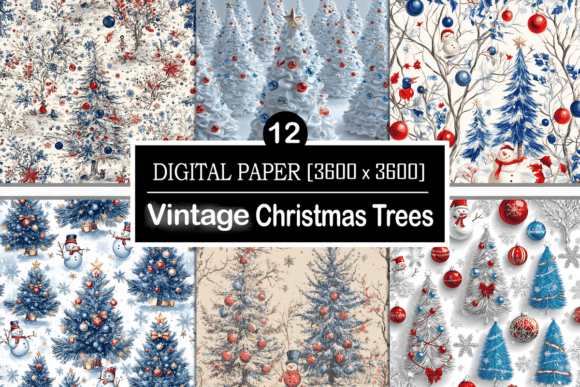
3D Vintage Christmas Trees: A Practical Guide to Quality and Authenticity
The resurgence of mid-century aesthetics has made 3D vintage Christmas trees a staple for digital creators, print-on-demand entrepreneurs, and hobbyists seeking nostalgic charm. Whether you are designing a holiday greeting card, creating assets for a game, or printing physical ornaments, these digital models offer a unique blend of warmth and technical precision that standard modern assets often lack. However, the term "vintage" in the 3D marketplace is frequently misapplied, leading to frustration when the final render or print fails to capture the intended era-specific character. Understanding the distinction between genuine retro design and merely old-looking geometry is the first step toward successful projects.
Distinguishing True Vintage Design from Generic Nostalgia
A common misunderstanding among beginners and even some experienced marketers is assuming that any low-poly or textured tree qualifies as vintage. True 3D vintage Christmas trees are defined by specific historical manufacturing constraints and stylistic choices, not just a sepia filter or reduced polygon count. Mid-century aluminum trees, for example, have distinct radial symmetry and metallic sheen properties that differ vastly from the flocked, irregular shapes of Victorian-era reproductions.
When evaluating assets, look for geometric accuracy rather than artistic approximation. If you are aiming for a 1950s aesthetic, the tree should reflect the mass-produced perfectionism of that decade’s aluminum extrusion technology. Conversely, if your goal is a rustic 19th-century feel, the model should exhibit hand-carved imperfections and organic asymmetry. Using a generic "old tree" asset for a historically specific campaign creates a subtle cognitive dissonance for viewers familiar with the era. This lack of specificity can reduce engagement in marketing materials or diminish the perceived value of commercial products. Always verify the historical reference points of a 3D model before integrating it into a period-accurate scene.
Technical Pitfalls in Texturing and Lighting
The most frequent technical error occurs when creators apply modern physically based rendering (PBR) workflows to vintage subjects without adjustment. Vintage decorations were rarely made of materials that interact with light like modern plastics or synthetic fabrics. Aluminum trees rely on specular highlights and anisotropic reflections, while paper-mache or cotton batting ornaments depend on subsurface scattering and diffuse absorption. Applying a standard glossy plastic shader to a vintage cotton tree model will instantly break the illusion, making it look like a cheap contemporary decoration rather than a cherished antique.
To avoid this, prioritize texture maps that include surface wear, oxidation, and material-specific aging. Clean, seamless textures often read as artificial in a vintage context. You should also be wary of baked lighting in downloaded models. Pre-baked shadows limit your ability to integrate the tree into new environments and often carry artifacts from previous renders. Opt for models with clean UV maps and separate texture channels so you can control the aging process yourself. For those using 3D vintage Christmas trees in animation or real-time applications, ensure the texture resolution supports close-up viewing without revealing pixelation, as vintage details like tinsel strands or glass beadwork require higher fidelity to remain convincing.
Evaluating Topology for Print vs. Screen
Creators often overlook the intended output medium when selecting 3D vintage Christmas trees. A model optimized for a background render in a video game may be entirely unsuitable for 3D printing, yet many marketplaces list them interchangeably. Game-ready assets frequently use normal maps to fake geometric detail, resulting in flat surfaces that look terrible when printed. Conversely, high-fidelity sculpted models designed for cinematic renders may possess non-manifold geometry, internal faces, or excessive density that causes slicing software to fail or results in prohibitively long print times.
Before purchasing or downloading, inspect the wireframe view. For 3D printing, the mesh must be watertight with consistent wall thickness. Delicate vintage elements like glass hooks or thin tinsel branches often need to be thickened digitally to survive the printing process. For screen use, check the edge flow and poly count relative to your target frame rate. A beautiful but unoptimized vintage tree can bottleneck a real-time scene. If you plan to use the asset across both mediums, budget time for retopology or seek out creators who explicitly provide separate print-ready and render-ready versions. Assuming one file serves all purposes is a costly mistake that leads to wasted filament or crashed render farms.
Licensing and Commercial Viability
For entrepreneurs and small business owners, the legal clarity of 3D assets is as important as their visual quality. The vintage aesthetic is popular, but the licensing terms for 3D vintage Christmas trees vary wildly. Some assets are released under Creative Commons licenses that prohibit commercial use, while others allow modification but restrict resale of the raw file. A significant risk arises when creators assume that because a design looks "old," it is in the public domain. While the original physical object may be antique, the specific 3D scan or digital recreation is a new creative work protected by copyright.
- Verify the license type: Ensure it explicitly covers your intended use case, whether that is merchandise, client work, or personal portfolio pieces.
- Check for trademark issues: Some vintage designs are associated with specific brands that still hold active trademarks, even if the style feels generic.
- Document attribution requirements: Many free or low-cost vintage assets require credit in the final product; failing to do so can result in takedown notices.
- Assess exclusivity: If you are selling products featuring the tree, determine if the license allows exclusive use or if competitors can legally use the identical asset.
Neglecting these checks can lead to platform bans, legal disputes, or the need to rework entire product lines. Always read the full license agreement, not just the summary tag. When in doubt, reach out to the creator for clarification or commission a custom model to secure clear commercial rights.
Integration and Scene Composition Strategies
Even a perfect 3D vintage Christmas tree can fail if placed incorrectly within a composition. Vintage items carry visual weight and cultural context that demands appropriate staging. Placing a pristine 1950s aluminum tree against a hyper-modular, sci-fi backdrop without narrative justification creates confusion. Similarly, mixing incompatible vintage eras—such as pairing a Civil War-era feather tree with 1970s disco-ball ornaments—can undermine the authenticity you worked to achieve.
Approach scene building with curatorial intent. Research color palettes, lighting temperatures, and prop styles specific to the tree’s era. Vintage incandescent bulbs emit warmer, softer light than modern LEDs; matching your virtual lighting to historical reality enhances believability. Consider scale relationships carefully; vintage trees were often smaller and more compact than today’s floor-to-ceiling displays. Oversizing a vintage model can inadvertently make it look like a modern parody. By treating 3D vintage Christmas trees as historical artifacts rather than mere decorative clip art, you elevate the quality of your work and connect more deeply with audiences who appreciate genuine craftsmanship and thoughtful design.